The excellent David Epstein just published a post on avoiding choking, inspired by the performance of Ilia Malinin, the so-called “quad god” who is widely considered the best in the world. I’ve been obsessed with the Olympics since I was a kid: every few years, without fail, everything in my life fades into the background as I look up the rules of curling, the technique of the Fosbury flop, and watch people rejoice in fulfilling their lifelong dreams.
I didn’t come from an athletic family, and used my first book as an excuse to learn a better mindset. When researching Can You Learn to Be Lucky?, I extended my deadline and added an extra chapter on sports expertise (Why Gold Medalists are Inherently Lucky) and turned myself into a guinea pig in order to put the research to the test. Good "sports genes" don't really apply to CrossFit — the sport encompasses everything from strength training to complex gymnastics skills to endurance — making it an especially fun ground zero for performance psychology.
.jpg)
Ilia Malinin, undefeated for two years, fell apart after popping a quadruple axel attempt, as intrusive thoughts flooded in. Epstein’s framing draws on solid research: skills “deautomize” under pressure. Your brain’s explicit attention system hijacks what your body already knows how to do, and overthinking a jump instead of just doing it causes choking and the “yips.”
Epstein’s advice is reasonable: keep your conscious mind busy so it can’t interfere, but impossible when your routine is long enough to require conscious thought (i.e., when you’re not simply swinging a golf club). Build a diversified identity — don’t make skating your whole self. Expect things to go wrong.
Good advice. Accurate advice.
Advice written on neutral ice.
Yesterday, I watched as Amber Glenn — three-time reigning U.S. champion, oldest American woman to qualify for an Olympic figure skating singles event since 1928, openly queer, openly bisexual, outspoken about her anxiety and depression and ADHD — landed a clean triple axel, one of only two women in the entire competition to do so. She held it together through the hard stuff before losing focus on the last jump. A double loop where a triple was required meant zero points for the element, dropping her to 13th place.
“I just lost focus, wasn’t feeling good.
“When… you were coming off the ice, we heard you say ‘I had it.’”
“Yeah, I did the hard stuff, so I was just in shock.”
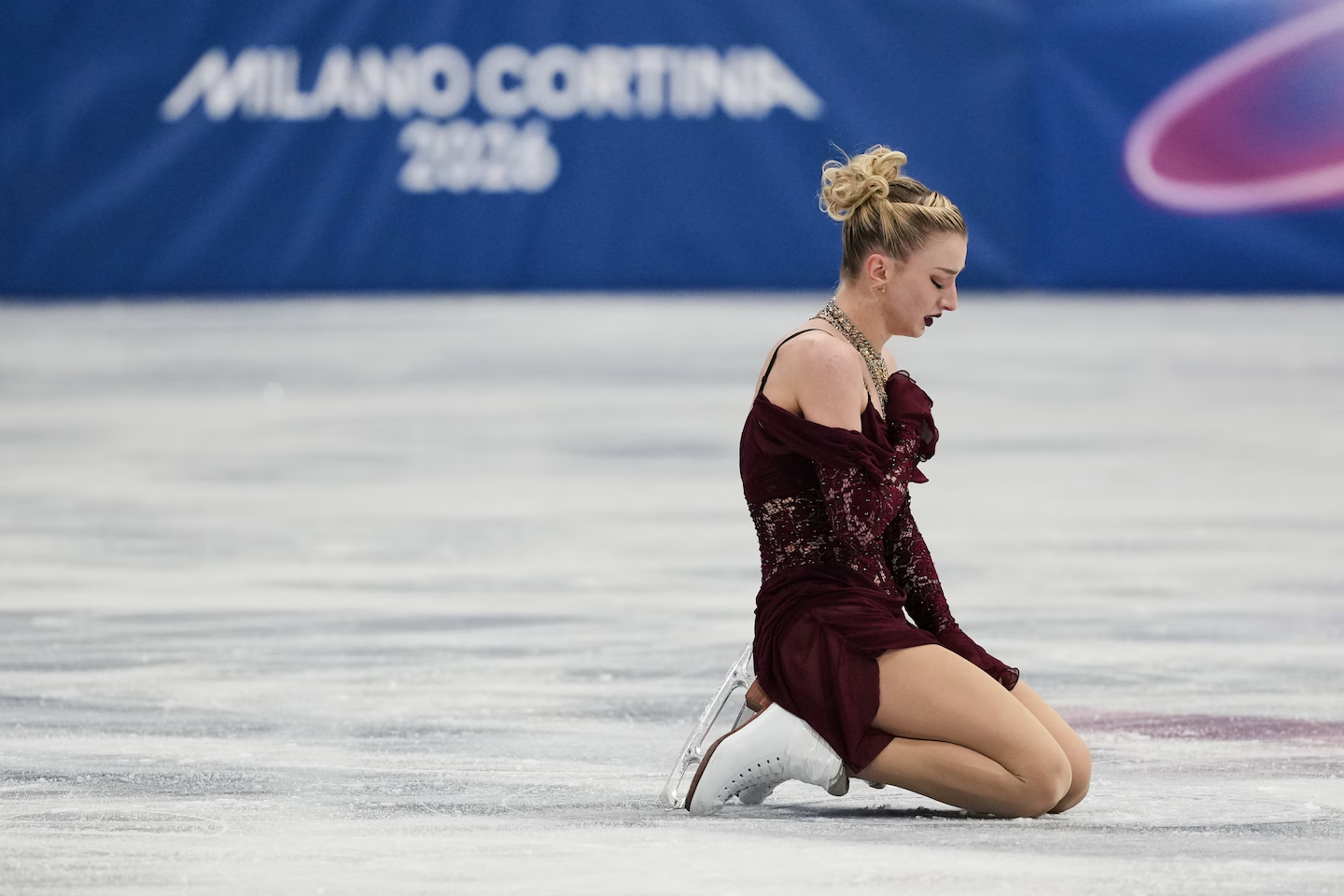
Doing the Hard Stuff and Then Losing Focus
Performance psychology’s choking literature tends to assume that pressure is situational. Identity is background. The performer is a neutral body that stress occasionally disrupts.
But Amber Glenn didn’t walk onto that ice as a neutral body: she walked on as a queer woman in a historically heteronormative aesthetic sport, at 26 in a discipline that gives women’s bodies a shorter lifespan, making her Olympic debut after a decade of near-misses and team selection controversies, days after publicly criticizing the Trump administration’s treatment of the LGBTQ community at a pre-Olympic press conference, wearing a Madonna-approved dress, carrying the symbolic weight of being the first openly LGBTQ women’s singles skater on Team USA.
She also had to land a triple axel.
In Epstein and Malinin’s story, performance fails when execution shifts from automatic to monitored — when you start watching yourself instead of doing the thing. But Glenn didn’t choke on the triple axel; she choked on the exhale. It’s not surprising, given how much mental bandwidth had been running in the background.
Stereotype threat, the idea popularized by psychologist Claude Steele, is when performance suffers because of a conflict between identity and performance. Olympic sports are still male-dominated; women made up 47% of the athletes at the 2026 Milano Cortina Winter Games, the most gender-balanced Winter Olympics to date. (From 1900 to 1924, any female Olympian hopeful had a short list of sports to choose from: golf, tennis, archery, swimming, figure skating, and fencing.)
From a stress perspective, this is chronic background activation — a constant hum of vigilance. Over time, that raises baseline stress levels, which makes acute pressure moments (like a test, presentation, or competition) more likely to tip into choking.
Being a sexual minority adds another layer:: the added pressure of representing the LGBTQIA+ community, of being someone who “revolutionizes the sport,” simply by being there. It’s like trying to land a triple toe loop while carrying a backpack full of social history that you have to forget about so you can focus—while you have ADHD, which Glenn has also openly struggled with.
Having ADHD makes it that much harder to “simply focus.” After colliding with another skater, Glenn suffered from a concussion and has since had regular training with a neurotherapist. Other athletes benefit from mental training—but having ADHD (which I also have) means adding yet another layer of difficulty to achieve the same kind of focus that comes naturally to others. Given the amount of repetition, focus, and long-term commitment required to become an Olympic-level athlete, making it there when you have ADHD is once again adding another 15 pounds of rocks to an already-heavy backpack.
This isn’t about mental weakness. It’s about carrying more of a cognitive load while having less bandwidth.
The press mentions her resilience admiringly, with good reason: coaching changes, selection controversies, a concussion, a decade of near-misses, a 2021 team selection where she finished second at nationals and still didn’t make the World Championships team. The New York Times called hers “A Story of Perseverance.” Whereas Malinin was raised by two Olympians who knew the entire elite athletic landscape, Glenn’s parents worked extra shifts and took extra jobs.
But resilience at this level isn’t a trait. It means that she had a bumpier road—having to self-advocate through systems that weren’t built in her native language. Self-advocacy, practiced over years, can shape your mental landscape into something resembling hyper-vigilance from the inside: an increased mental load from scarcity, where your family’s livelihood is on the line. Always calibrating for signs of being an outsider. Always aware that your position is constructed and hard-fought, not inherited. Even when you’ve embraced yourself, your body and mind keep the score.
Vigilance is adaptive, but it’s also a cognitive tax. One that compounds under pressure.
Epstein’s other suggestion is to imagine things going wrong beforehand, and mentally rehearse failure so it loses its power when it arrives. Good advice if failure is something you have to consciously conjure.
If you’re a queer outsider from Texas with ADHD who’s battled mental health issues, whose family fought to be there, performing in a body that’s doubly objectified, and the narrative is you’re 26 and past your prime—you probably don’t have to imagine failure.
Glenn had been skating with the heavy, hypervigilant backpack of you don’t belong here, this isn’t your path reminders for years—that’s the unsung tax of resilience, running in the background. When that is your default, letting your guard down is the dream, the unique utopian horizon—which is exactly what Glenn did after she “did the hard stuff” and “lost focus.”

The Complexity of Identity Complexity
Epstein cites psychologist Sian Beilock’s research on identity diversification as a buffer against choking. The logic: athletes with multiple identities — skater and parent, competitor and artist — are less devastated by any single failure because the self isn’t all in one place. You have other eggs in other baskets to cushion a failure.
But when it comes time to focus, self-complexity can backfire. Patricia Linville’s self-complexity research — the actual theoretical backbone here — found that multiple identities buffer stress when they’re independent. The protection comes from compartmentalization: a bad day at work doesn’t contaminate your sense of yourself as a parent. Identities can insulate each other, if they point in a coherent direction.
For Malinin, “athletic excellence” harmonizes with his other identities. Family, national pride, masculine archetype, media framing — they all pull in the same direction: a win is a win; a fall is a fall.
But self-complexity becomes destabilizing when identities are pointed in different directions, publicly salient, politically charged, and under simultaneous threat. Lifting weights is harder when you have to suppress the non-gym guys who will feel threatened and laugh at you for “looking like a bro,” or the women who tell you that you don’t look very feminine—there’s more noise to silence; having a book-to-be-published to look forward to might make it easier to fail a lift, but lifting is also harder when a coauthor scolds you for spending 45 minutes away from the manuscript.
When a bad skate doesn’t just threaten the athlete identity — it activates the queer representation identity, the gendered stereotype threat, the media narrative, the personal consistency story. All at once. Under Olympic spotlight, more identities means more evaluators in the room. More internal and external monitoring. More meaning assigned to each moment — which is exactly the wrong cognitive state for a sport requiring narrowed, automatic execution.1
Choking emerges when attention shifts from action to self-evaluation. Epstein knows this. What his model doesn’t account for is how many evaluators some athletes or performers walk in carrying before the music even starts.
Ilia Malinin is Not Universal
Malinin choked. His explanation was vivid and honest: traumatic memories flooding in, negative thoughts he couldn’t manage. That’s real. That’s a choking event. But Malinin walks into competition as the son of elite skaters, embedded in figure skating’s lineage, in a sport that rewards the masculine-coded technical aggression he’s built his career on. His belonging feels structural. His age reads as runway. His misses get framed as ambition and risk, the fault is externalized: too much media attention.
Epstein’s interventions — external focus cues, pre-planned contingencies, diversified identity — aren’t wrong. They’re just not the whole story. The most interesting thing Epstein’s piece does — without knowing it — is use Malinin as the universal case study for choking. Not as a choice, just as a default. The research is about human performance, and Malinin is the human performance that happened to be available.
That’s how epistemological blind spots work: not planned or malicious bias, but an invisible assumption that the default example is neutral, its lessons universal.
For everyone else, they’re advice written for a body that isn’t theirs, on ice that was never quite neutral to begin with.
Amber Glenn nailed the triple axel. She did the hard stuff.
The last jump landed somewhere between fatigue and history.
Both things can be true.
So how do you avoid choking?
Here’s the thing with writing about those with marginalized, complex identities: any concrete advice will be necessarily be incomplete. And data-driven advice falters for others whose lives aren’t even measured in the first place. Because of that, here’s what worked for me:
- Mastering the art of self-regulation. With complex identities and overly-confident thought leaders and coaches, you are bound to receive conflicting advice. But only you know what you need on a moment-to-moment basis—don’t discount that.
- Surround yourself with reminders of your awesomeness. Engage in constant acts of self-compassion. In a world that profits off of our misery, rewards the performance of constant perfection, with algorithms that seem to magnify the angriest voices and bloodiest news, what you think of as extra self-compassion is probably just enough. One framework calls this adaptive perfectionism: going after the good thing because you want to,being kind to yourself when you come up short, and immediately reframing everything as a learning experience. It’s not “soft” or “weak.” It’s simply the mindset that’s most adaptive to preventing burnout, and staying on the road to your goals in the long run.