When writing my first book, I had a dream of giving a TED talk. Think of early TED talks: a gloriously messy Malcolm Gladwell on an equally messy stage. The humor! Jill Bolte Taylor on her “stroke of insight.” The feels! Hans Rosling geeking out about statistics! Tim Urban being funny on procrastination! Simon Sinek passionately nerding it up about circles!
While they’re all smart, funny, insightful and somehow surprising, what strikes me is the shared passion among the speakers.
Do you remember Sir Ken Robinson’s nearly 20-year-old discussion of how schools kill creativity? It’s a glorious time capsule for many reasons, including the Easter egg at 14:57 showing a bald Jeff Bezos laughing when he was still in human form:
At 75 million views, Robinson opens by praising the conference specifically for “the extraordinary evidence of human creativity in all of the presentations... just the variety of it and the range of it.” It seemed like the pinnacle of thought leader coolness.
So imagine how tickled I was to get an invite.
Me and data, a love-hate story
After spending over a decade studying behavioral science and writing my well-received first book, I was contacted by a professor at Stanford business school to write a second one, which, as a writer, I gladly did for money. We ultimately wrote a guide called Making Numbers Count: The Art and Science of Communicating Numbers, which led to me teaching Data Storytelling in Will Storr’s Business Storytelling class for NYU professor Scott Galloway’s online business school, then called Section4.
In the months following my initial lectures, I gave workshops and talks to a variety of businesses and NGOs, and eventually got an email from a curator at TEDx who had been a student at Section4. But not just any TEDx… the largest one.[mfn]Disclaimer: TEDx is NOT the same thing as TED. Each TEDx is individually operated and curated, and my experience with the TEDx event in the most populated city in the world’s most populous country is not an indictment of TED entire or any other TEDx organization. Alas, even case studies are information worth noting. I’d love to give a TED or TEDx talk, but acknowledge that publishing this has likely maddened the powers that be. So be it.[/mfn]
What do you want me to say about data? I asked. That’s like saying, please give a talk on words!
I proposed a few talks, including:
How to Prove Anything: I’ve come to think of data as pixels—snapshots of the world in a given point in time. We think it tells us all, but real life is a movie: a constantly moving, dynamic web that can never be fully mapped out. Data offers us the illusion of objectivity. When we leave out the big picture, cherry-pick, or misrepresent it, we can prove just about anything. Instead of a blind trust in numbers, we need to teach how to not be afraid of asking questions; knowing how they fit into the whole picture is the only way they’re valuable.
Other ideas?
- “The Silent Variables.” Let’s pretend numbers don’t even exist.
- “Lagging Indicators.” What if we won’t really know what’s important or causing the changes for a while.
- “Goodhart’s Law.” When a measure becomes a target, it ceases to be a good measure.
Caveat: I Hate Numbers
I’ve now delivered enough talks and workshops to be comfortable shaping ideas with conference directors, akin to a writer working with an editor. You start with and agree on the kernel of an idea, then zoom out to hit the right notes and present the ideas in a way would resonate most with the audience. I do genuinely enjoy collaboration.
But I hate numbers.
Which is why I was excited about the idea of pretending that numbers don’t exist and thinking about them differently. Towards the end of researching Making Numbers Count, I read Invisible Women by the amazing Caroline Criado Perez. Minds were blown. It was a final stake through the heart of my belief in numbers as objective measurements; we’d already been leaving out info that made Chip uncomfortable.[mfn]We hadn’t even included any female researchers until I created a color-coded Google spreadsheet to show how lopsided it was.[/mfn]
We treat numbers like untouchable arbiters bestowing objective purity from above, when in reality they are records of a momentary blip of certainty in the quantum chaos of the universe, devoid of context. The same processes of data collection used today have historically been used to justify bad findings, repress entire groups, and claim legitimacy as a science; but even physicists have to make subjective decisions.[mfn]My current favorite book is Theodore Porter’s Trust in Numbers: The Pursuit of Objectivity in Science and Public Life. See also The Tyranny of Metrics, by Jerry Z. Muller. Muller introduces an idea that he dubs “metric fixation,” which often leads to unintended consequences: “It occurs because not everything that is important is measureable, and much that is measurable is unimportant.”[/mfn] I thought that this would be a good counterintuitive start for a TED talk, and was willing to go to whatever lengths and put in all the work to have a photo of myself standing on a red carpet.
TED’s early halcyon days
The intersection of lectures and white people demanding attention isn’t new; I attended Dent last year and had an unbelievably great time at what many people said “reminded them of TED in the early days.” Of all the conferences, why did TED break out in the first place?
Years ago, in a study made famous by Malcolm Gladwell’s Blink, researcher Duncan Watts created an online interface where subjects could go online to download and rate songs. In some (but not all) conditions, users could see how often the songs had already been downloaded. The worlds free of social influence thrived on quality—the same groups of songs clustering towards the top and bottom.
But additional information skewed the results and snowballed a song’s success to erratic ends: “Lockdown,” a tune by 52metro, was #40 in one scenario and #1 in another. “In general, the ‘best’ songs never do very badly, and the ‘worst’ songs never do extremely well, but almost any other result is possible,” reported Watts.
In a deleted chapter in my first book, I examined which cultural items get lucky and break out. Here’s a stab:
- Be consistent with the branding: the first information that people get. Branding and packaging direct our attention and frame how we interpret it.
- Get high quality recordings of the best talks—great marketing for both the speakers and the conference. Only release those to cultivate an air of exclusivity. As far as anyone knows, you only date 10s.
- Find your niche and be consistent and surprising within this niche; TED’s seemed to be “minimally counterintuitive,” just interesting enough to spread.
TED’s first breakout talks hit all of these and felt like widespread cultural touchstones. There’s a gloriously messy Malcolm Gladwell on an equally messy stage. The humor! Jill Bolte Taylor on her “stroke of insight.” The feels! Hans Rosling geeking out about statistics! Tim Urban being funny on procrastination! Simon Sinek passionately nerding it up about circles! They’re all smart, funny, insightful and somehow surprising; form mirrors content. They’re also pretty varied.
These early-era talks were special (each video began “once a year, 1000 remarkable people gather in Monterey, California”) making it hard to envision that they’d undo this scarcity and exclusivity. A promotional video for the 2012 film Prometheus envisioned Guy Pierce-as-tech-CEO making a TED talk in the then-futuristic 2023; TED was still an annual affair, but had grown to a giant drone-filled stadium:
The Growth and Metrics Machine
But exclusivity gave way to meteoric growth. To date, there have been nearly 45,000 TED and TEDx gatherings, and an estimated individual 250,000 TED/TEDx talks delivered. It’s still cool, but a less impressive feat. (The social club SoHo House faced similar criticism when it went public, only to go private again last year. Endless growth is not inevitable, and staying small has its perks.) To maintain the TED brand mystique, founder Chris Anderson created brand guidelines and formulas that one imagines are more comprehensive each year, which each group, one imagines, adheres to more tightly than others.
And so it begins…
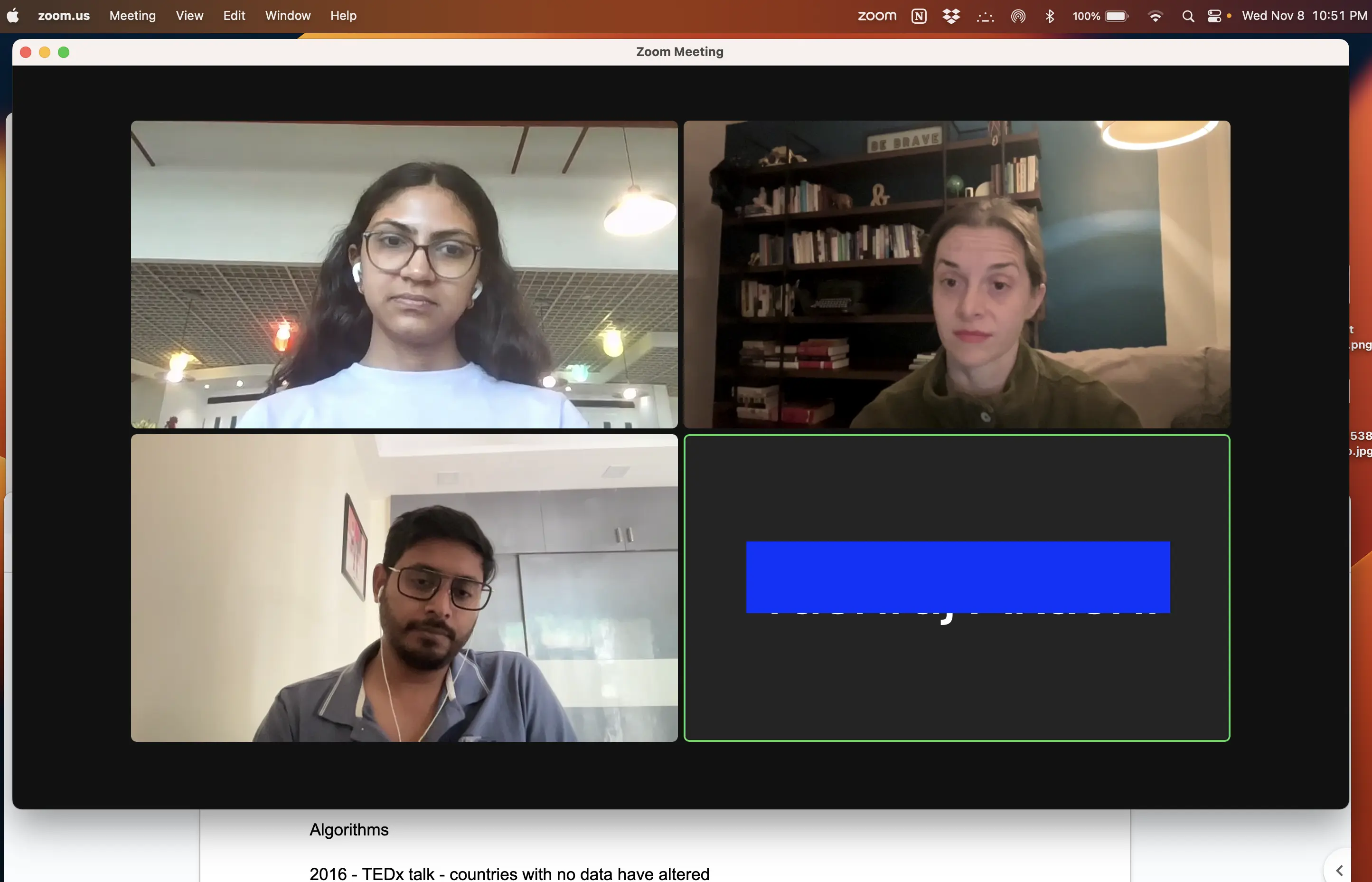
A few weeks later, I was on a Zoom call with 3 other people, getting feedback on my proposed topics from the speaker team, who had collected notes from many other teams of people they’d met with.
“We got your topics—we are very excited to be working with you!!”
Thank you!
“Yes, we like this one, but we were looking up a few other talks on those same topics… they did not perform very well. So we need a new angle.”
Well those people aren’t as funny as I am, I bet… haha, and there are many reasons why those talks might not have performed very well! It’s not just the topic.
“We will send you a list of the other confirmed speakers for the conference, and a list of our speakers and talks from the past several years, so you can make sure to not duplicate any of these.”
Got it.
“And a few people on our team aren’t very excited about data. So perhaps we should back up a little bit: who is this talk for?”
Audience members? Hahaha… people who want to think about data in a new way.
“No. Our audience is very savvy, and will have heard everything before. But this talk is for everyone who will be watching the talk online. You are competing with their phones. So we also have to think of SEO.”
You know: pick a better movie than Citizen Kane. I’d expected this to be a challenge and was up to the task. Finally, I was presented with a sort of Holy Grail: the official TED course on how to give a good talk.
Best Practices
My talk at the first-ever NeuroDiversion attests to the idea that the first year of any conference depends on few guidelines and lots of trust. It’s that trust that creates talks like the initial breakouts. In the early Wild West days of TED, talks emerged from a singular personality and passion (that already had public speaking experience) being given the stage for 18 minutes. Passion and emotions are contagious.
In attempting to reverse-engineer that with the TED course, we imagine that TED founder Chris Anderson and co. watched tons of talks, identified patterns, and then built a curriculum around them:
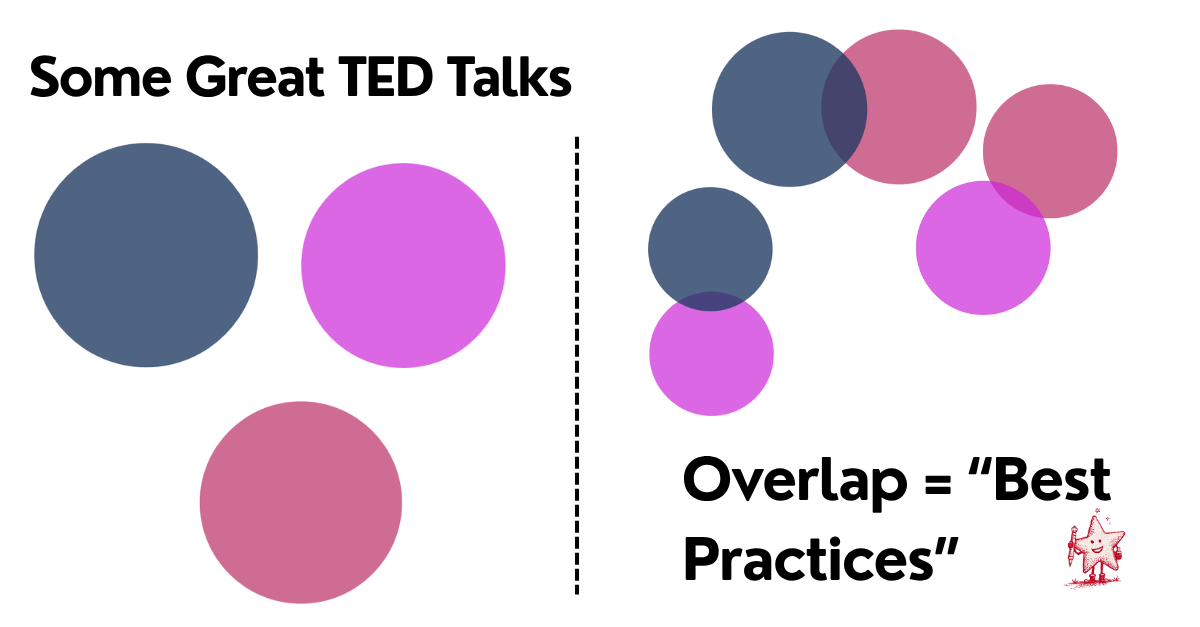
The conference organizers supervised me as I watched the video course on Zoom at 11pm; modules include “What are ideas; What are your ideas; What is your throughline; How to craft your presentation plan; how to find your voice; how to connect with your audience; How to explain complex ideas; How to be persuasive; How to artfully reveal your ideas.”
Obsessing over what they think will lead to more views—with each sentence parsed by teams of people—creates a talk that is SEO-optimized by committee. It’s the equivalent of the famed ‘90s experiment, The People’s Choice Music, by artists Komar and Melamid. The Most Wanted Song combined people’s favorite musical elements, proving that only using what’s popular leads to Mr. Beast, bland media, and forgettable beige, while the Most Unwanted Song contained “bagpipes, cowboy music, an opera singer rapping, and a children’s choir that urged listeners to “do all [their] shopping at Walmart!” It is 22 minutes long and it is legendary.
Having every team of people weigh in on every sentence leads to micromanaging, soul-crushing, and formulaic blandness—the very opposite of thought leadership and individual passion.
One of my talk ideas, remember, was on “Goodhart’s Law”: when a measure becomes a target, it ceases to be a good measure. When “views” becomes a target, we’re obsessing over what’s measurable. Robinson observed that every education system ranks subjects the same way — mathematics and languages at the top, arts at the bottom — because the hierarchy was built around utility in the workplace and what’s measurable—and teaching to the test results in training people for the skillsets and priorities of professors. Hilariously, the course itself is a direct rebuttal of the lessons in Robinson’s talk.

What the metrics can’t capture is whether any of it is doing what Ken Robinson stood on that stage in 2006 and described, transmitting the genuine variety and range of human thought. The principles are not geared towards sharpening the ideas themselves, but towards the optimization of the appearance of being worth spreading.
Dan Gilbert (whose Stumbling on Happiness is beyond brilliant) is cited as the pinnacle of how to artfully reveal your ideas. But his method broke out largely because a) it was surprising at the time, and b) each video felt like an event when they were only releasing a few top videos each year. Many of these talks happened to have shared some traits—they weren’t built by exclusively using these shared traits.
In video 5, Dan Pink is quoted as saying: “Don’t try to be the next Ken Robinson or the next Jill Bolte-Taylor. Be the first you,” while the entire video course tries to tell speakers how to be like Robinson and Bolte-Taylor. We strip away the non-shared elements, make assumptions that no one likes talks on this topic, become obsessed with not making mistakes and create what is indistinguishable from AI slop.
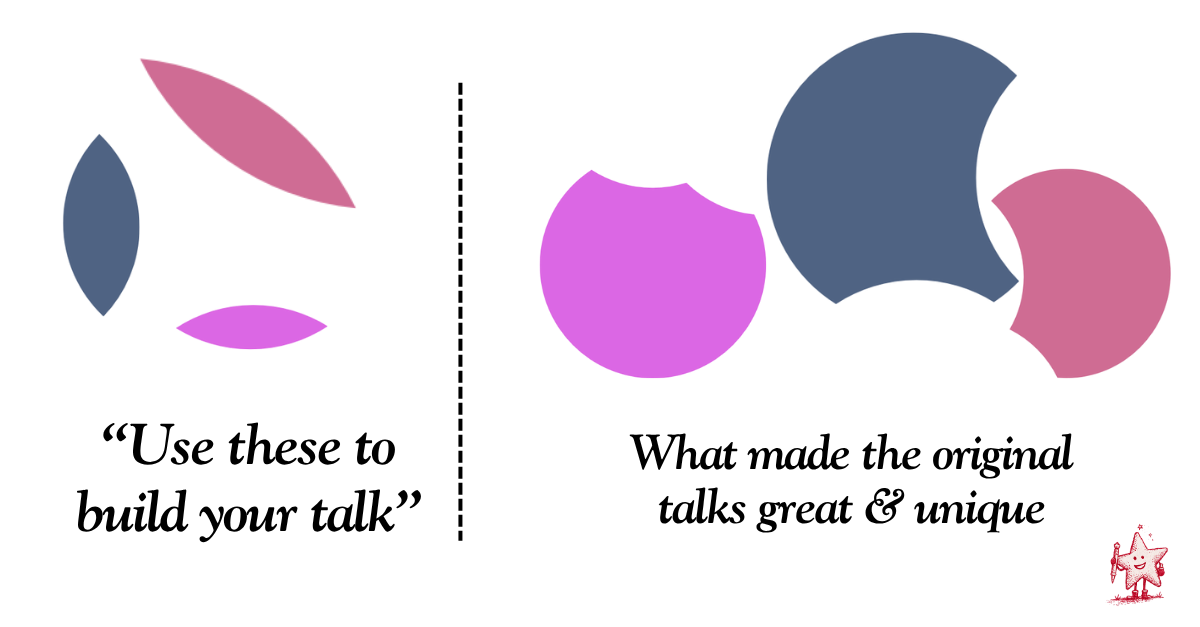
“The only thing that truly matters in public speaking is not confidence, stage presence, or smooth talking. It’s having something worth saying,” says Anderson. The remaining 10 videos are almost entirely about confidence, stage presence, and smooth talking: packaging the ideas.
Robinson’s talk wouldn’t have made it to the TED stage today—with his unique asides, lack of actionable takeaways, playing rough and ready with the time limit. It’s a glimpse of his authentic inner nerd and it stands out because it’s not like the other talks.
When we try to assemble cultural items with only the optimized parts, we lose sight of how those parts fit together.
I spent months developing ideas and scripts for the six minute talk, spent a fortune on clothes, and excitedly told everyone I’d ever met. By the end, I got such whiplash (“brilliant!” became “so we ran this past someone else, and they don’t like it…” from call to call) that I remember saying something I’ve never said before or since: please, just tell me what you want me to say and I’ll say it.
And I meant it. I couldn’t figure out why they’d invited me in the first place, I just knew that I was going crazy. For free.
The TEDxGateway organizers rescinded my invitation less than two weeks before the actual conference. And what became of the fruits of this devotion to the gods of SEO best practices that they ran through each and every sentence? How did those talks perform that followed the formula for breakout talks?
I’ve never heard anything about them.